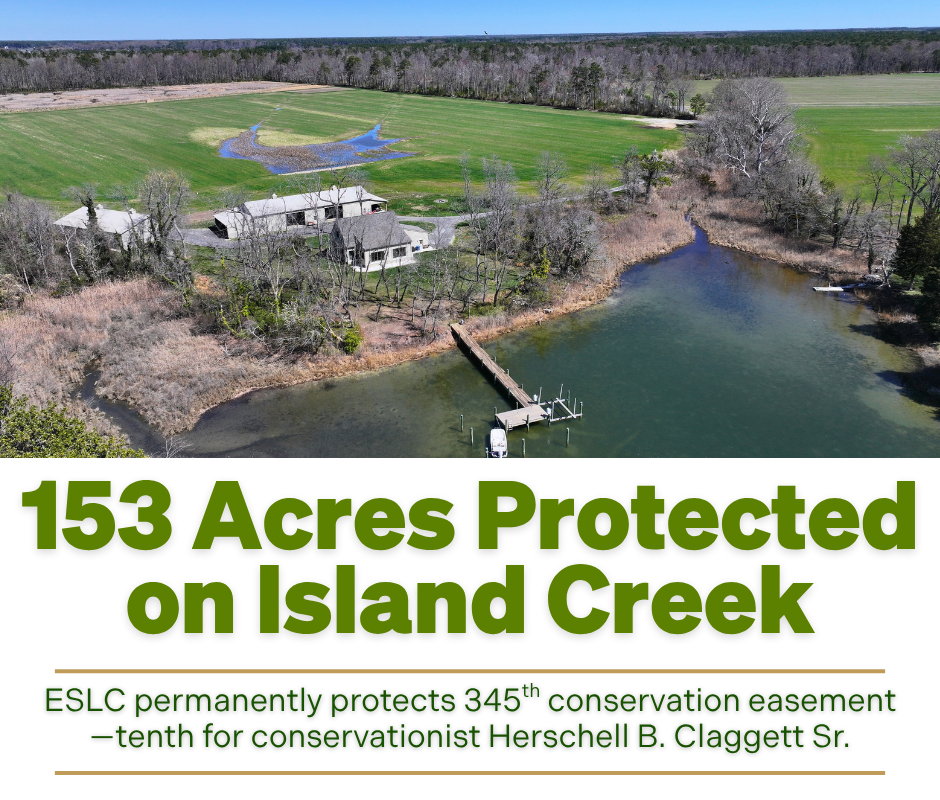
More than 153 acres just outside of the town of Oxford, Maryland have been permanently conserved by Eastern Shore Land Conservancy. The new ESLC easement completes the full protection of Herschell B. Claggett Sr.’s 213-acre farm, 60 acres of which are protected through a USDA Wetland Reserve Easement. A longtime supporter of ESLC and ardent conservationist, this is the tenth conservation easement for Herschell B. Claggett Sr., whose protected lands lie in Talbot, Caroline, Queen Anne’s, Kent, and Cecil Counties. Three of these easements have been completed by ESLC, the most recent funded as a Maryland DNR Conservation Reserve Enhancement Program (CREP) Permanent Easement. The CREP Permanent Easement program simultaneously conserves active agricultural fields and protects waterways by strategically removing select field edges and riparian buffers out of production to be maintained as streamside buffers, wetlands, and wildlife habitat. This means Claggett’s 86 acres of grain fields are surrounded by eight acres of grassland buffer strips that will filter nutrient pollutants from nearby Island Creek, a tidal tributary of the Choptank River and the Chesapeake Bay. Alongside the farm’s 60 acres of wetlands, roughly half of the ESLC easement lies within Chesapeake Bay Critical Area.
“ESLC is grateful for the support and conservation efforts of forward-thinking conservationists like Herschell Claggett,” commented ESLC President & CEO Steve Kline. “The notable water clarity we are seeing on Island Creek, the Choptank River, and across the Eastern Shore is inextricably tied to healthy land stewardship like the field buffers, cover crops, forest conservation, and other soil health stewardship and sustainable agriculture practiced on this property and hundreds of others protected by ESLC.”
The easement also protects 450 linear feet of shoreline on Island Creek, 3,700 feet of scenic road frontage along World Farm Road, and corn and sunflower fields that are mindfully managed with cover crop rotations and reduced herbicide. 48 acres of mixed conifer and deciduous forest provide essential habitat for FIDS (forest interior dwelling species of birds) like tanagers, ovenbirds, and wood thrushes. The protection of Claggett’s farm brings ESLC’s conservation of FIDS habitat to a total of 4,111 acres in Talbot County alone. Many FIDS species are neo-tropical migrants that migrate north for the summer, stopping in Eastern Shore forests to nest and breed. These seasonal residents are not only a delight for birders (and so a benefit to Eastern Shore tourism) but are also an essential part of our culture and ecosystem, dispersing native seeds throughout their stay, and reducing crop damage for Eastern Shore farms by providing free natural pest control as they consume beetles, aphids, and caterpillars. Recent studies have shown that avian agricultural benefits are only increased when farms conserve natural habitat like the CRP buffers and woodlands now permanently protected on Claggett’s farm.
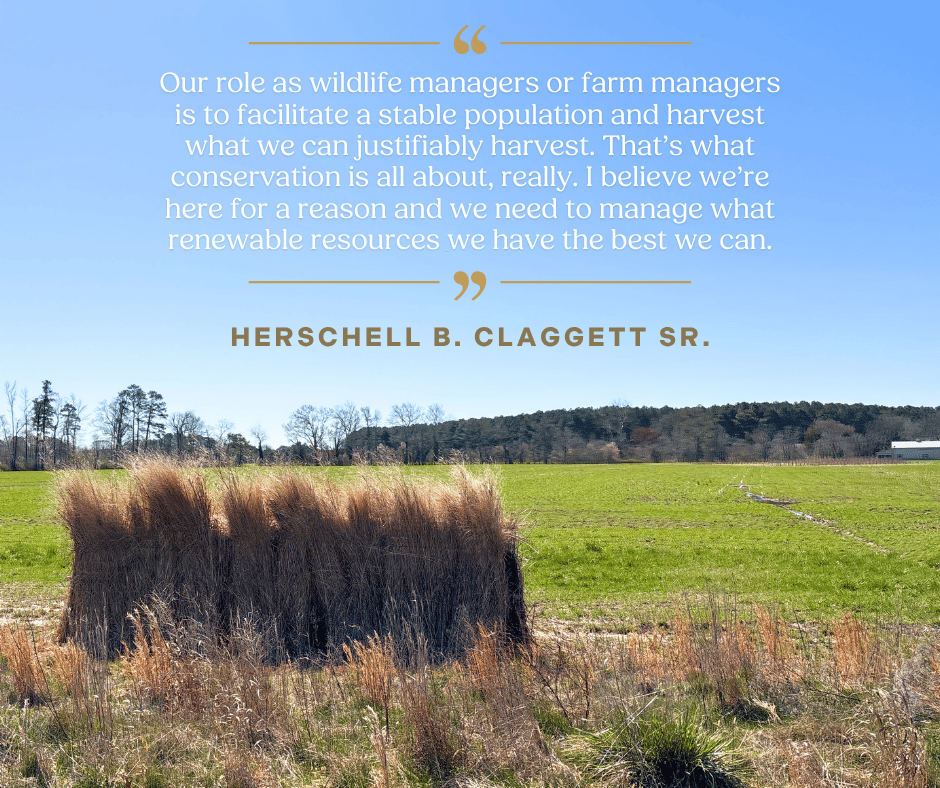
Reflecting on his easements and the essential role farming and hunting play in conservation efforts, Claggett said, “Our role as wildlife managers or farm managers is to facilitate a stable population and harvest what we can justifiably harvest. That’s what conservation is all about, really. I believe we’re here for a reason and we need to manage what renewable resources we have the best we can.” Claggett remembers when the first no-till planter was used on the Eastern Shore, and now it’s used on every one of the properties he’s conserved—just one of the many management practices that have helped to protect and improve habitat for the river otters, deer, diamondback terrapins, waterfowl, eagles, and wild turkeys he delights to see on his land. Claggett is hopeful for the continued innovation and adaptability of Eastern Shore farmers and for the impacts of conservation easements on our waterways and communities. “I’d like to think this easement is going to help,” he said. “And I think it has.”